"Evil is powerless if the good are unafraid" - Ronald Reagan

Alaska
        
California
        
New York
        
GMT
        
Germany
        
Kuwait
        
Iraq
        
Afghanistan

Iraqi Security Forces detain 4 suspected extremists (Mahmudiyah)

Udoubtedly as a result of the raid that netted Thirty-two most-wanted extremists near Salmon Pak, MNF-I is reporting that two more cell leaders have been detained in Mahmudiyah.

Iraqi Security Forces, advised by U.S. Special Forces, detained two suspected extremists and two extremist cell leaders in separate raids Jan. 4.

In Mahmudiyah, south of Baghdad, Iraqi Special Operations Forces detained two suspected extremists who are believed to be responsible for the kidnapping and murder of Iraqi citizens, weapons trafficking as well as attacks on Iraqi and Coalition Forces.

During the course of the operation, the assault force received small arms fire from an individual near the target objective. Iraqi and U.S. Forces engaged the individual, killing him.

Labels: , ,

Arabs Back General As Lebanese President

Well at least the title of this Washington Post article gets it right even if the first paragraph gets it wrong.

Syria joined other Arab nations Saturday in endorsing the head of Lebanon's army as that country's next president, putting pressure on the Lebanese opposition to drop demands that have blocked a compromise over the post.

The way this is written leads one to presume Syria led the charge for allowing the election of Gen. Michel Suleiman for president.

During a meeting in Cairo, Arab foreign ministers agreed unanimously to back Commander Gen. Michel Suleiman for president and called on Lebanon's rival parties to resolve their political differences.

Syria's decision to back the statement suggested that the Lebanese opposition - led by the Syrian-backed Hezbollah - maybe ready to drop its demand that it receive Cabinet veto power before allowing Suleiman to be elected.

Syria, through Hezbollah, has been preventing Suleiman's selection as president until this point by pressuring March 14 members to give Hezbollah 1/3 of the ministersial seats in parliament, allowing them to veto any legislation not acceptable to them, even though this is more than their representative sample.

Read the entire article here.

Bhutto's servant under scanner

In an interesting twist, Bhutto's servant, Khalid Shahinshah is now wanted for questiong over her assassination according to The Times of India.

An absconding servant of slain former premier Benazir Bhutto, who aroused suspicion with his "strange gestures" while she was delivering her last address in Rawalpindi last week, could provide a clue to her killing, Pakistan People's Party workers said.

Khalid Shahinshah, who was hired by Bhutto on the recommendation of her security advisor Rahman Malik, has been on the run ever since footage emerged of the strange gestures he had made while standing on the dais next to Bhutto while she addressed an election rally.

Shahinshah was standing on Bhutto's left during her speech and ran a finger across his throat which implied slitting the throat. Security officials have expressed concern at his "suspicious gestures" which could not be ignored.

We will continue to watch this story as it develops. For the full read, click here.

Labels: , , , ,

It's the secular Left vs. the Christian Left

Mark Steyn discusses the results in Iowa as only Mark Steyn can.

Confronted by Preacher Huckabee standing astride the Iowa caucuses, smirking, "Are you feelin' Hucky, punk?", many of my conservative pals are inclined to respond, "Shoot me now."

But, if that seems a little dramatic, let's try and rustle up an alternative.

To read the full article, click here.

Labels: , , , , , ,

Musharraf: Bhutto bears responsibility for death

President Musharraf in an interview for 60 Minutes to be aired Sunday has apparently stated that Bhutto bears responsibility for her death.

Pakistan President Pervez Musharraf conceded that a gunman may have shot Benazir Bhutto but said the opposition leader exposed herself to danger and bore responsibility for her death, CBS News said on Saturday.

He appearently specifically said,

For standing up outside the car, I think it was she to blame alone. Nobody else. Responsibility is hers," Musharraf said in the interview taped on Saturday morning.

Musharraf also apparently conceded Bhutto was shot.

Musharraf was asked by CBS, which provided excerpts of the interview, whether a gunshot could have caused Bhutto's head injury. He replied, "Yes, yes."

The questioner asked, "So she may have been shot?" and Musharraf said, "Yes, absolutely, yes. Possibility."

For the full read, click here

.

Labels: , ,

Iraqi Security Forces Order of Battle: January 2008 Update

D. J. Elliot gives a laydown on the current Iraqi Security Forces Order of Battle at The Long War Journal.

The January 2008 updates to the Iraqi Security Forces Order of Battle are now available at the ISF OOB Page. The significant changes to the Order of Battle are summarized below.

On December 14, the quarterly report to congress was released. The details have been addressed in "Iraqi Security Forces continue to surge" and only updates or changes to that report will be addressed in this update.

On December 15, the ninth of 18 Iraqi provinces transferred to Iraqi control. Basrah marked the halfway point in the turnover of Iraqi provinces and a major shift in Iraqi forces to cover the southern provinces. According to previous reporting, Ninewa Province is due to transfer to Iraqi control in the February or March timeframe and Anbar is speculated to transfer in the April or May timeframe. Baghdad Province is planned for Provincial Iraqi Control in August 2008. Baghdad is expected to be the last province to transfer to Iraqi control.

The entire update can be viewed by clicking here.

The Battle for Diyala - 04-05 January 08

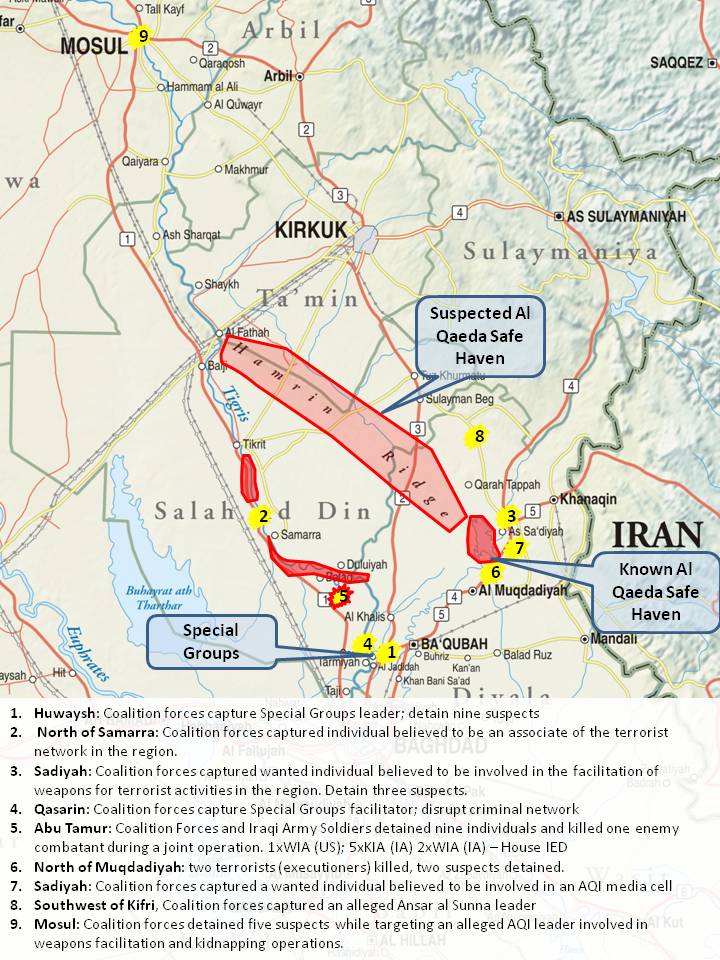
The Battle for Diyala continues with Coalition Forces conducting a series of raids. The below picture details a series of MNF-I Press Releases from 04 to 05 January 2008. Click on the image to enlarge.


Coalition forces continue to use actionable intelligence to kill or capture Al Qaeda in Iraq and Special Groups in the Diyala Province. As one can see from the image above, Coalition forces are continuing to encircle Al Qaeda where they have established a base of operations in the lake in the Kanaqin district of the Diyala province. Once Coalition Forces are able to rout Al Qaeda from the lake, they will have successfully cut off their major line of communication between the Hamrin Ridge and Baghdad.

The Hamrin Ridge has been a known safe haven and training location for Al Qaeda earlier in the war and as late as October 2007. This ridge is dotted with many caves that allow Al Qaeda to hide plus the mixture of Arabs, Turkomans and Kurds allow Al Qaeda to hide among the area's mix demographic population.

In addition, Coalition Forces also are using actionable intelligence to kill or capture Al Qaeda in along the Tigris River Valley from Balad to Samarra to Tikrit. This action will close Al Qaeda's remaining line of communiction in the MND-N's zone.

It is in these locations that remaing 25% of Al Qaeda is attempting to regenerate it command and control structure and re-estblish its base of operations. As part of Operation Phantom Strike, a corps-level offensive, MND-N, Iraqi Army, and Special Forces are attacking Al Qaeda in their last remaining safe havens. The operation aims to prevent al Qaeda, Sunni, and Shi’a insurgent elements from reconstituting their forces in Baghdad, its belts, or elsewhere. U.S. and Iraqi forces seek to destroy the remnants of enemy groups and eliminate any new safe havens they try to establish. Their operations are also aiming to prevent Shiite militias from taking over territory once controlled by al Qaeda. This is why Special Groups are also being targeted.

Bilawal is target now: Lal Masjid cleric

The Daily Times of Pakistan quoted Taliban cleric Maulana Mohavya Irshad, from the Lal Masjid, or red mosque, as saying,

"Bilawal is a target now...." "I don’t know much about Bilawal. I only know he is a liberal person which is a deviation from Islam. True Muslims will not allow him to go against Islam." "These true Muslims will be horrified to see an image of Bilawal dressed as the devil while standing besides a pretty girl at a decadent party at Oxford University."

While many folks try to point fingers at Musharraf for Bhutto's assassination, we have leading Taliban clerics all but pointing fingers at their next target. We have Al Qaeda and The Taliban initially claiming credit for Bhutto's assassination, but given the uproar that followed her death, these elements have since not formally taken credit. Yet, we again have leading Taliban figures coming forward threatening death to her son, Bilawal.

While Musharraf's government has not handled the assassination properly, nor has Zardari, who initally refused an autopsy on Bhutto and recently rejected Musharraf’s offer of a probe by Scotland Yard and demanded that a United Nations commission should conduct the investigation into his wife’s death.

Now we have reports of seven suspected suicide bombers having entered Rawalpindi and Islamabad to sow the seeds of more unrest.

Pakistan created the Taliban and tacitly supported Al Qaeda in its borders. It now is quickly becoming the second central front in their global jihad. One can only hope that the PPP and Musharraf can put their differences behind them and work to fight a common enemy.

True Muslims should not be "horrified to see an image of Bilawal dressed as the devil", instead they should be horrified of the numerous devils in Al Qaeda and the Taliban within their boarders.

Labels: , , , ,

Fatah (and Hamas) lose support among Palestinians

The Jerusalem Post reports that Palestinians are losing faith in not only Fatah, but also Hamas.

Fatah still commands a strong lead over Hamas that controls Gaza, with 39 percent of Palestinians trusting it, as opposed to 16 percent backing for Hamas. But in November, 46 percent of those surveyed for a similar poll favored Fatah, and 13 percent backed Hamas.

Forty-one percent of those polled said they didn't trust either faction, up from 32 percent in November.

The article goes on to state.

While most Palestinians trust and approve Fatah's peace moves, they have little trust in Fatah's ability to improve their own living conditions, said Jamil Rabah, director of Near East Consulting.

"People don't have a problem with the thinking and ideology of Fatah, but they are not happy with the symbols and leaders of Fatah," Rabah said. "They are getting so much money, but will they bring an end to the (deteriorating) situation?"

A plurality of Palestinians (41%) do not trust Fatah or Hamas to improve their living conditions despite donor nations promising $7.4 billion over the next three years. In addition, Palestinian trust and approve of Fatah's peace moves.

Hamas took over Gaza due to is popularity slipping. The polls show their coup has not helped their popularity, standing in the teens.

So, what is the significance here?

First, this is the first poll I have seen that a plurality (41%) do not trust Fatah or Hamas

Second, this is also the first poll I have seen where a majority ("most" according to the article) want peace with Israel.

Third, Hamas, who won the Palestinians first elections, now only have support of 16% of the population.

Finally, Palestinians only had a choice between two parties in their first democratic election. Having lost faith in Fatah, they brought Hamas into power. Having seen that Hamas also does not have their best interest at heart, Palestinians became disenchanted Hamas. However, instead of support moving to Fatah, it has now moved to a third, yet undetermined faction or faction who will lead the Palestinians to peace with Israel and serve the people who elected it into power.

I have stated this before in this blog. The fascinating dynamic of the January 2006 election is not that the Palestinians were able to freely elect Hamas into power, but that Hamas (and Fatah) could be unelected in the future if they did not govern for the people since they were now elected by the people.

It now appears the Palestinians would vote both parties out of power. This is the gift the Palestinians were given in January 2006. Many concluded the Palestinians squandered this gift by voting Hamas into power. I contend they did not vote Hamas into power as much as they voted Fatah out of power due to its inability to govern for them. For its part, Fatah rather peacefully conceded power, a first for Palestinians.

Fatah, for its part, seems to have generally gotten the message, and its leaders are attempting to govern for the people to a certain extent. Hamas, on the otherhand, conducted a coup in Gaza to maintain its hold on power. Both parties poll data reflect accurately the amount of trust Palestinians now put in their parties.

Israel should use this poll data to push for peace with the Palestinians. In addition, America should help the Palestinians find a leader for the disenchanted 41% who neither favor Fatah or Hamas and who will govern for the people.

However, even without America's or Israel's meddling, the Palestinians were given a special gift, the gift of democracy, in January 2006. As with all young democracies (including our own), it initially has to overcome significant graft, develop the spirit of a democracy, and fully understand what a democracy gives to its people. This two year old democracy is still young and learning. It is no older or wiser at this point than is a toddler. In fact, some may say, it has entered into its "terrible twos". Yet, this young democracy will continue to grow and florish. It will go through puberty, sweet sixteen, and finally become a respectable adult providing for it children.

Everybody wants to end the Palestinian crisis, but what is forgotten is the Palestinian Liberation Organization (PLO) was ended on January 2006. It is now something completely different. It is a democracy. Its people were liberated, not from the Israelis, but from their own totalitarian rulers. Yes, Hamas brought forth a coup in Gaza to retain power, but Fatah is moving ahead with peace towards Israel and peace for its people. Right now there are two divided Palestinian areas, but over time, the power of the people will reunite these separated people.

George Washington gave this country a gift on 23 December 1797. Another George gave the Palestinians a gift on 25 January 2006 as part of the Bush Doctrine which declared one of the goals of the United States was to spread of democracy to prevent the rise or continuation of terrorist's regimes. While not yet a fully developed democracy, the Palestinian people are going through their "terrible twos" enroute in their path to get there.

Labels: , , , ,

Key Al Qaeda Deputy Killed in Iraq (And 32 Most-wanted Terrorists Captured Too)

CNN, is reporting a key Al Qaeda deputy was killed in Iraq on 27 December 2007.

Muhammad Khalil Ibrahim, identified as the deputy military leader for the al Qaeda's network south of Baghdad, was killed along with two other terrorists in the air strike on their vehicle on Dec. 27, the military said.

Ibrahim was "a key planner in numerous attacks against Coalition forces operating in the Mahmudiyah area, and was also involved in the facilitation of foreign terrorists and weapons," the military said.

CNN's title of this article, "Key al Qaeda deputy killed in Iraq," misses a more significant operation noted in subsequent paragraphs in the article.

On Saturday, the U.S. military and Iraqi Army launched an assault south of Baghdad in the Ubaydi farmland area, described by one U.S. soldier as a place where "people are either aligned with al Qaeda in Iraq or they've been killed or chased away."

More than 40 suspected extremists were captured, including 32 that were on the Iraqi Army's "most-wanted list," the military said.

Coalition forces captured 32 extremists on the Iraqi Army's "most-wanted list." This operation is simply astounding and displays the level of intelligence penetration and coordination of forces currently being brought to bear against Al Qaeda in Iraq. Thirty-two most-wanted extremists were captured in one operation.

Not only was the deputy military leader for the al Qaeda's network south of Baghdad killed along with two associates on 27 December 2007, but two days later, during an apparent high level meeting, 32 senior Al Qaeda leaders were capture.

The inference that this meeting was a high level one is supported by the facts that a relatively small cache was recovered during the raid (four 120mm mortar rounds and 80 rounds of 20mm) and such a large number of cell leaders were present.

The raid took place along the Tigris River 20 miles south of Baghdad putting it in the Salmon Pak area, normally associated with the "triangle of death" where three US Soldiers were kidnapped in May 2007. Another important piece of information CNN does not tell us in their article is that 200 Iraqi Army and Policemen (half of the total force) were also involved in the raid. Again, the importance of this fact should not be sidelined. We have a high level meeting taking place with 32 most-wanted Al Qaeda members and Iraqi Forces are trusted with the intelligence of this raid beforehand and did not warn these 32 most-wanted Al Qaeda members. In fact, the operation on the southernmost of the three main objectives was planned, led and executed entirely by Iraqi soldiers.

These facts taken together demonstrates the once corrupt Iraqi Police Force have been made relatively free of corruption as they were used for the outer cordon. Iraqi Army Forces not only planned, led, and executed the operation, but found three of the 32 captured terrorists in a spider hole, again showing the level of expertise and lack of corruption in the Iraqi Army.

So four significant facts come out of this article when combined with other information that CNN did not feel important to highlight in this article.

1. This operation was an Iraqi planned, led, and executed raid (for the southernmost objective).

2. The level of corruption in Iraqi Security Forces has definitely been reduced otherwise this raid would not have netted 32 most-wanted terrorists.

3. Three of the 32 terrorists were found in a spider hole showing the level of expertise of Iraqi Forces.

4. A major terrorist network has been wiped out in Southern Iraq which led operations in the notorious "triangle of death" area south of Baghdad which ran through Salmon Pak and Mahmudiyah to Baghdad.

One can only hope the capture of 32 Al Qaeda leaders in this region will also help US force recover its two missing Soldiers.

Labels: , , ,

Rival Shiites in Iraq Try to Make Peace

Bradley Brooks, from AP reports that Al-Sadr representatives met for a second time in a week to resolve their differences and make peace.

Representatives of radical Shiite cleric Muqtada al-Sadr met Thursday with officials from his chief rival's party in an effort to cement a tenuous peace agreement the two signed in October after violent clashes between their followers.

It was at least the second formal overture al-Sadr has made to Abdul-Aziz al-Hakim and his Supreme Islamic Iraqi Council, the largest Shiite political party, in less than a week.

Peace between the two — who each control powerful militias — is seen as key to preventing the outbreak of widespread fighting in oil-rich southern Iraq, where the British military recently handed over responsibility for security to Iraq's government in Basra, the last province it controlled.

Hakim is not only pursuing peace with Al-Sadr, but also with Sunnis,

Separately on Thursday, al-Hakim called for unity among Shiites, arguing that closing ranks would benefit the whole of Iraq since they are the majority.

"Every one must work to support and boost this unity," he told supporters in Najaf.

He also acknowledged the contribution of Sunni militias, which have more than 70,000 members, to the decline in violence and called for their use in the continuing fight against al-Qaida in Iraq.
"Today, we are witnessing the decline of terrorism and the progress of reconciliation on the popular level with Sunni-Shiite solidarity," he said, alluding to the government's perceived failure to achieve political reconciliation among Sunni, Shiite and Kurdish groups.

Hakim and Sadr are worried about the "memorandum of understanding" between the Kurds, Sunnis and Maliki's Dawa party that would exclude them from power in Baghdad. We will see if this works.

Hezbollah dismisses senior commander for wartime failures

Haaretz is reporting,

Hezbollah has recently removed the head of its anti-aircraft units from his position, according to Western intelligence agencies, apparently as part of the conclusions drawn by the Lebanese militant organization from the Second Lebanon War in 2006.

As reported on 16 December 2007 in this blog, Tehran removed Nasrallah as military commander of Hezbollah and assigned Kassam most likely due to Nasrallah's entry and subsequent handling of the Second Lebanon War.

However, this removal could mean Kassam is beginning to clean house in Hezbollah militay as this is the second removal in less than a month.

Kenya's Descent into Anarchy

Threatswatch, Clay Varney has a great article to understand the current crisis in Kenya.

The previously stable and economically prosperous East African nation of Kenya has erupted in a spasm of deadly post-election violence resulting in the deaths of over 300 individuals in a few short days. The unrest began soon after evidence of improprieties in Kenya’s December 27 presidential election emerged. The election pitted the incumbent, President Mwai Kibaki, against Raila Odinga of the Orange Democratic Movement, who was running ahead in polling prior to the election. Kibaki was deemed the winner, but allegations of vote-rigging by Kibaki and his supporters have been alleged by Odinga and backed up by Western observers. As protests exploded in anger over the results, the confrontations between supporters of the two candidates have taken on the decidedly unsavory flavor of ethnic conflict. The Kikuyu tribe, of which President Kibaki is a member, has been targeted by members of Odinga’s Luo tribe and vice versa, with the involvement of other tribes as well. There are more than 40 tribes in Kenya with Kikuyus as the most numerous tribe at 22% of the population, a group that has traditionally composed the country’s most prominent figures in government and commerce. Luos comprise 13% of the population and have a history of animosity with the Kikuyu.

Click here to read the article in full.

We are at war with hatred, fanaticism and despair

William Shawcross has writen an article for The Spectator.co.uk which reminds us what we are at war against.

First of all we have to give up the luxury of pretending that the war with Islamism is our fault. It is not. It is a deadly serious attempt by reactionary theocrats, Sunni and Shia, to enslave as much of the world as possible. It is powerful — it has the resources of a rich state, Iran, behind its Shia arm, and oil wealth gushes into the coffers of its Sunni side.

He continues with,

Secondly, the murder of Bhutto should also demonstrate — yet again — that this war is not the fault of the Israelis. The Islamists did not kill Benazir Bhutto because of concern about the West Bank. They killed her because they feared her power to give the Pakistani people more than the Islamists want them to have, and because they seek to push Pakistan into total chaos and unlimited carnage.

Moreover,

Third, Iraq is not the cause of this war — it is part of it. Remember one of the first terrible suicide murders committed in Iraq: in August 2003 al-Qa’eda killed Sergio Vieira de Mello, one of the UN’s most gifted officials, and many of his colleagues. De Mello was Kofi Annan’s special representative in Iraq and, like Annan, was opposed to the US war effort there. But al-Qa’eda denounced Annan as ‘America’s criminal slave’ and abused de Mello as ‘diseased’. They hated him in particular because he had helped Christian East Timor win independence from Muslim Indonesia — a heinous crime to al-Qa’eda.

And finally,

The murder of Bhutto, the murder of UN officials, the countless murders of innocent Iraqis, the murder of Lebanese who fight for their democracy, the murder of commuters in Madrid and London are all part of the same war against people and life. They are all part of the same deadly global ideology of hatred and despair. These assaults will not end if we retreat — from Afghanistan, from Iraq or anywhere else. Weakness will cause the terrorists to redouble their efforts.

These reasons are why we cannot pull out of Iraq, why we cannot let Pakistan fall to Al Qaeda, why we cannot let Iran acquire nuclear weapons, and why we must continue the fight in Afghanistan.

We are in a global war against fanatics who want to impose worldwide shria law, destroying democracy in the process, suppress all kinds of freedoms, especially of women, and as the author states, "destroying all that is best in our imperfect world."Yes, democracies such as America's does have its flaws, but it is definitely far better than the alternative our enemy's want for us.

Hizbullah Leader Nasrallah: 10 Days To Resolve Lebanon Crisis – Or Else

MEMRI is reporting that Nasrallah has given Al-Siniora's March 14 government 10 days to resolve the crisis in Lebanon or they will take,

"legitimate civilian measures, and will not promise that matters will not descend into the streets."

Since Lebanese have not been able to agree on a President, Siniora has become the defacto President in accordance with the constitution. Hezbullah wants over 1/3 of the parlimentary seats in the new government which would allow it to effectively veto any March 14 legislation. Siniora and Lebanese Druze Leader Walid Jumblatt have stated they will not give into Hezbullah's demands as it would give

the opposition the justice portfolio would endanger the establishment of the international tribunal for the assassination of former Lebanese prime minister Rafiq Al-Hariri.

The battle in Lebanon is a crucial political battle in the War on Terror. Success of the March 14 government will severely weaken Syria and Iran. Since Nasrallah is now not in charge of the Hezbullah Army, he can only conduct "civilian measures" in hopes of gaining ground, unless Kassam orders the Army into action. However, this would put Hezbullah in direct confrontation with the Lebanese Army which is deployed throughout Beruit; possibly inciting another civil war.

We will keep a watch on this area to see what develops.

Labels: , ,

Taliban, military clash in South Waziristan, Swat

Bill Roggio, writing for The Long War Journal, has an excellent update on Pakistan military actions in the FATA regions.

Fighting between the Taliban and the Pakistani military has been reported in the Taliban stronghold of South Waziristan and the settled district of Swat. In South Waziristan, the military is attacking Baitullah Mehsud's Taliban after the kidnapping of four soldiers, while in Swat the army continues its slow advance through the former vacation spot.

He continues with,

In Swat, the Pakistani military is continuing to fight a slow campaign in the settled district. The military was last reported to have advanced as far as Bahrain in central Swat, yet it is still fighting in the Matta and Kabal areas which it claimed to have secured over a month ago.

And finally,

After declaring a state of emergency at the beginning of November, President Pervez Musharraf said operations in Swat would be completed by Dec. 16, and resorts would be reopened shortly afterward. The state of emergency was lifted Dec. 14, but the military is still conducting operations in regions it reportedly secured early on.

To read the entire update, click here.

The Battle of Diyala

A close examinaton of MNF-I Press Releases will give one a sense of where the battle against Al Qaeda in Iraq is currently focused. And that focus is in the Diyala Province where it is reported that the remaining 25% of Al Qaeda is holding out. Al Qaeda is attacking Coalition forces and civilians in this area. First MNF-I reports,

Two Multi-National Division – North Soldiers were killed in a small-arms fire attack while conducting operations in Diyala province Jan. 3.

Additionally, one more MND-N Soldier was injured in the attack and evacuated to a Coalition Forces’ hospital.

A further MNF-I report states

Coalition forces killed seven terrorists today during operations targeting al-Qaeda in Muqdadiyah.

Coalition forces targeted associates of an al-Qaeda in Iraq leader allegedly responsible for coordinating and directing a large terrorist group, and carrying out executions in the Diyala River Valley region. Intelligence reports indicate the group killed at least two people execution style in the last few days and has engaged with Coalition forces on multiple occasions. This operation follows several weeks of coordinated raids against this group by Coalition forces.

Another MNF-I press release states,

Coalition forces killed two terrorists and detained 12 suspects today during operations targeting al-Qaeda in central and northern Iraq.

Coalition forces conducted two coordinated operations north of Muqdadiyah targeting associates of the al-Qaeda in Iraq network operating in the northeast Diyala River Valley region. The targeted individuals are associated with the leader allegedly responsible for directing a large terrorist group that conducts executions in the region. Intelligence reports indicate the group recently executed two people and has been engaged in numerous fire fights with Coalition forces over the last few weeks.

This same press release also states,

Southwest of Kifri, Coalition forces captured an alleged Ansar al Sunna leader for the network operating in the Diyala region. The wanted individual is allegedly responsible for numerous attacks against Coalition forces. Reports also indicate the suspect was previously injured during an Iraq forces operation, and he allegedly escaped from the hospital with the help of other terrorists, killing five Iraqi policemen during the escape.

Farther north in Mosul, Coalition forces detained five suspects while targeting an alleged al-Qaeda in Iraq leader involved in weapons facilitation and kidnapping operations.

And finally, AFP is reporting,

The Iraqi army ordered an indefinite ban on vehicle traffic from Friday morning across Diyala province, north of the capital, one of the most dangerous areas of the country.

"Owing to the bad security situation in Diyala province, the Diyala operations command will impose an indefinite vehicle curfew on Friday all over the province from the morning," provincial military operations chief Brigadier General Raghib al-Omeiri announced in a statement late Thursday.

The provincial capital Baquba has been hit by a spate of shootings, suicide attacks and roadside bombings in recent days.

US assistant commander in chief for northern Iraq Brigadier General James Boozer told a news conference on Wednesday that the Diyala towns of Baquba and Muqdadiyah were the key areas of violence in Iraq, along with the main northern city of Mosul.

As reported in this blog before,

Operation Iron Hammer activities stopped just south of Muqdadiyah and was followed up on with Operation Iron Reaper after newly acquired intelligence changed the focus of the operation. Iron Reaper involved four U.S. brigades participated in Operation Iron Reaper, along with three Iraqi Army divisions, likely the 2nd, 3rd, and 5th IA. Operation Iron Reaper targeted the Khalis Corridor in Western Diyala province, certain pockets in Salah ad Din province and the Za'ab Triangle and Western Mosul in Ninawa province.

However, neither operation pursued Al Qaeda north of Muqdadiyah, where Al Qaeda has established a base of operations in the lake in the Kanaqin district of the Diyala province. It appears now that Coalition Forces (typically Special Forces since the unit is not named) as part of MND-N are now beginning to execute operations north of Muqdadiyah in the Diyala river valley to close in on Al Qaeda last remaining stronghold. In addition, MND-N forces are continuing to move north up the Khalis corridor to rout out Al Qaeda remenants in this region.

Taking all these press releases/reports together and reading Bill Roggio's report on this area, it would seem that MND-N is beginning an offensive into the Al Qaeda's safe havens from the lake in the Kanaqin district of the Diyala province along the Hamrin Ridge.

In one of the reports above, it is noted, "Southwest of Kifri, Coalition forces captured an alleged Ansar al Sunna leader for the network operating in the Diyala region." Kifri is a town about 50 miles north of Muqdadiyah, just southeast of Sulayman Beg, but more importantly east of the Hamrin Ridge, a suspected Al Qaeda in Iraq safe haven along with the lake in the Kanaqin district. Since the report does not list a unit, but instead states, "Coalition forces", it is suspected that Special Forces are operating in this region, in Al Qaeda's rear areas.

Take the suspected beginning of an offensive from Muqdadiyah to Bajii to the east over the Hamrin Ridge coupled with the fact of a vehicle ban in the Diyala province north of Baqaba (regardless of the stated reason), and Special Forces operating to the east of the Hamrin Ridge in Kifri, and we start to see a classic envelopment taking place against Al Qaeda forces in this region. Shaping operations for the upcoming battle are fully underway. The vehicle ban will make it easier to spot Al Qaeda forces repositioning or attempting to withdraw. Special Forces to the north of Muqdadiyah will only allow Al Qaeda two options, stay and fight or withdraw to Kanaqin along the Iranina border; thereby losing more ground and a crucial line of communication to Baghdad.

If Coalition Forces can secure the lake in the Kanaqin district, Al Qaeda's flank will be exposed along the Hamrin Ridge. Isolated on this ridge, Al Qaeda becomes easy pickings for manned or unmanned aircraft.

The stage is set; it is not only a matter of time until the decisive operations to defeat Al Qaeda in this region is undertaken. Given the vehicle ban, it may have already began.

Labels: ,

Petraeus Aide Denies Report That Iran Is Not Aiding Iraq Militants

Yesterday, I wrote of my confusion with regards to an article by Sara A. Carter writing for The Washington Times reports in which she reported.

Iran's leaders are no longer supplying weapons or training to Islamic militants in Iraq, the spokesman for the top U.S. commander in Iraq told The Washington Times.

Today, we get COL Steven Boylan take on this article.

Col. Steven Boylan told FOX News that the article, purported to include quotes from Petraeus and Boylan, "is inaccurate."

"We do not know if there has been a decrease in the supply of Iranian weapons," Boylan wrote to news outlets that picked up the Washington Times story. "It is not clear if Iran's leaders stopped supplying weapons or training to extremist elements in Iraq. We hope that they have, but until we can confirm it, we are in the wait and see mode.

"We have seen a decrease in the attacks using four specific types of Iranian weapons. However, this should not be misunderstood as anything other than lowered levels of attacks using these specific weapons," he wrote.

Like I stated yesterday, Iran will do what is in Iran's best interest and towards it future goal of having a Shiite Crescent from Iran to Lebanon.

While U.S Forces have seen a decrease in attacks using Iranina weapons, we do not know if this is because Iran is reducing the supply of these weapons, whether we are interdicting the shipment of these weapons, whether we are discovering them before the attack happens, whether we have killed or detained cells which emplace these weapons, or whether they are currently just being stockpiled at cache.

All these factors made me doubt the Washington Times article. Now with COL Boylan's correction to set the record straight, it seems that Sara Carter chose to believe what she wanted to believe vice what was actually stated.

The Big Winners

Richard Baehr has done some great analysis regarding the winners and losers in Iowa.

There were three winners in Iowa last night: Mike Huckabee, Barack Obama, and John McCain. The race in both parties has now changed, with the path to the nomination clearer on the Democratic side than the Republican.

For the Democrats

Barack Obama won decisively, by 8% over Edwards and 9% over Clinton. Voters under age 30 made up a fifth of the Democratic caucus voters and they gave over 50% of their votes to Obama. This has to make GOP strategists nervous about the general election if Obama is the nominee. Young voters are often not picked up in polling surveys, since many only use cell phones. Traditional election models may be useless if Obama is the Democratic Party nominee.

Regarding Clinton's inevitability.

Can Clinton recover? She has lots of money, and an infrastructure in place in many states. But her strength was the sense of inevitability about her winning, and her claim of long and meaningful experience. Neither was enough to win in Iowa. In Iowa, Clinton benefited from a strong race by John Edwards, which served to dilute the anyone but Clinton vote. Edwards does not have the money that Obama and Clinton have, and will likely be gone after South Carolina. His obsession with the Presidency will have to wait until 2012, assuming the GOP wins next year, or 2016 if they do not.

Regarding Obama.

Running against Obama is very tricky. It is hard to run against hope and unity, and breaking the color line and all that symbolizes. Yes, Obama is inexperienced. His instincts on dealing with the threat of Islamic jihadists suggests naïvete. They do not want to sit down and talk with us, not even him. But it may not matter. Obama is connecting with Democrats, independents, and some Republicans.

After the bitterness of the Clinton and Bush years, he is an analgesic, a fresh face, promising better times and a more peaceful politics. The Republicans may rue the day Obama won Iowa, since Clinton would be a far easier candidate to run against.

For the Republicans

Could Mike Huckabee actually win the nomination? I think he could, though his road to victory is much more difficult than Obama's. Huckabee will likely get a boost in New Hampshire from his big Iowa win (9% over Romney), but it is hard to see him following up the Iowa victory with one in New Hampshire. More likely, he finishes third in the Granite State, unless Romney's support collapses there and Huckabee places second.

What about McCain?

John McCain, who will finish in an approximate tie for third in Iowa with Fred Thompson, is in very good shape to win New Hampshire against Romney's damaged campaign. McCain was already ahead in New Hampshire, and his showing in Iowa was quite respectable given how little time he spent there. Within days, the national polls will show Huckabee and McCain running one two in that order or the reverse order.

Is this then a McCain-Obama race?

McCain would be a favorite against Clinton and 50-50 at best against Obama, unless the Obama glow wears off by then. An Obama-McCain race would feature huge contrasts: age difference, experience, maturity, positions on the Iraq war. McCain is close to the center, and can appeal to independents, like Obama. Their race, if it comes to this, would likely turn on whether foreign threats trumped the domestic agenda. At this point, more people want to talk about healthcare, the economy, the housing slump, than Iraq or Afghanistan or Al Qaeda. That works to Obama's favor.

Richard Baehr ends with this interesting note.

In the last 3 elections the winner in November also won Iowa. Last night might make it four in a row.

Labels:

Iraqi Shiite Praises Sunni Groups

al-Hakim praised Sunni CLC forces for their role in bringing down violence in Iraq.

Noting the decline in violence, he said the credit should go to the role played by the groups, adding: "We still believe in the necessity of continuing with this strategy."

"Today, we are witnessing the decline of terrorism and the progress of reconciliation on the popular level with Sunni-Shiite solidarity," he said, alluding to the government's perceived failure to achieve political reconciliation between Sunni, Shiite and Kurdish groups.

However,

Al-Hakim's take on the Sunni groups was not the only hint of his displeasure with the performance of the 19-month-old al-Maliki government, of which al-Hakim's Supreme Islamic Iraqi Council, or SIIC, is a major partner.

He subtly admonished the government for not doing enough to improve the lot of the poor or fight widespread corruption in government.

"The government must look for expertise and competence when it fills official posts," he said. "I am here repeating my earlier calls on the government to pay attention to the poor classes and ... low income employees."

While never a great supporter of Maliki (as Sadr's backing of Maliki prevented Hakim's party from securing the Prime Minister spot), one wonders why Hakim is publically praising Sunni groups at the expense of Maliki. It may have something to do with the recent "memorandum of understanding" signed between the Kurds and Sunni last December in which it appears that Maliki's Dawa party is loooking to build a unity government with Sunnis and Kurds.

Iraq: Al-Sadr makes another overture toward top Shiite leader

Al Sadr's people meet with Hakim party to further strengthen peace agreement which both parties signed in October 2007 according to the Jerusalem Post.

Representatives of the radical Shiite cleric Muqtada al-Sadr met Thursday with officials from his chief rival's party in an effort to cement a tenuous peace agreement the two signed in October after violent clashes between their followers.

It was at least the second formal overture al-Sadr has made to Abdul-Aziz al-Hakim and his Supreme Islamic Iraqi Council, the largest Shiite political party, in less than a week.

A delegation from al-Sadr's office in Kufa, led by sheik Muhanned al-Gharrawi, met with the Dhi Qar provincial governor Aziz Kadhim Alwan, a member of al-Hakim's party, and other local officials in Nasiriyah, about 320 kilometers southeast of Baghdad.

"The province should live in peace and security without armed violence and disorder," Alwan said after the meeting. Al-Gharrawi said the talks were meant to "end political and military" violence in the province and "to protect citizens' lives."

While signing an October agreement, it was not binding at the street level where violence still persists. It will be interesting if this meeting produces anything different than what already exists.

A cold spell soon to replace global warming

Oleg Sorokhtin reports via Russian Information Agency that a cold spell will soon replace global warming.

Earth is now at the peak of one of its passing warm spells. It started in the 17th century when there was no industrial influence on the climate to speak of and no such thing as the hothouse effect. The current warming is evidently a natural process and utterly independent of hothouse gases.

Ok, this is true, but

The real reasons for climate changes are uneven solar radiation, terrestrial precession (that is, axis gyration), instability of oceanic currents, regular salinity fluctuations of the Arctic Ocean surface waters, etc. There is another, principal reason—solar activity and luminosity. The greater they are the warmer is our climate.

Hold on, your telling me the sun, that big ball in the sky warms things like the Earth. Ok, I will accept this for now, but doesn't a gas, like CO2, which is currently at 383 ppm (parts per million) of the Earth's atmosphere have more effect than the sun which has 98% of the mass in the solar system and would hold 1.3 million Earths in it. Come on, what has more effect, the huge hot sun or 383 ppm CO2?

The temperature of the troposphere, the lowest and densest portion of the atmosphere, does not depend on the concentration of greenhouse gas emissions—a point proved theoretically and empirically. True, probes of Antarctic ice shield, taken with bore specimens in the vicinity of the Russian research station Vostok, show that there are close links between atmospheric concentration of carbon dioxide and temperature changes. Here, however, we cannot be quite sure which is the cause and which the effect.

Temperature fluctuations always run somewhat ahead of carbon dioxide concentration changes. This means that warming is primary. The ocean is the greatest carbon dioxide depository, with concentrations 60-90 times larger than in the atmosphere. When the ocean’s surface warms up, it produces the “champagne effect.” Compare a foamy spurt out of a warm bottle with wine pouring smoothly when served properly cold.

So you expect me to believe that the sun causes increases in CO2 and not that CO2 causes warming regardless of the sun.

Likewise, warm ocean water exudes greater amounts of carbonic acid, which evaporates to add to industrial pollution—a factor we cannot deny. However, man-caused pollution is negligible here. If industrial pollution with carbon dioxide keeps at its present-day 5-7 billion metric tons a year, it will not change global temperatures up to the year 2100. The change will be too small for humans to feel even if the concentration of greenhouse gas emissions doubles.

But I feel the warming now due to that bad, bad gas called CO2.

Carbon dioxide cannot be bad for the climate. On the contrary, it is food for plants, and so is beneficial to life on Earth. Bearing out this point was the Green Revolution—the phenomenal global increase in farm yields in the mid-20th century. Numerous experiments also prove a direct proportion between harvest and carbon dioxide concentration in the air.

Hold on now, I must protest. Are you saying plants grow better when it is warmer and more CO2 is in the atmosphere? How preprosterous?

Carbon dioxide has quite a different pernicious influence—not on the climate but on synoptic activity. It absorbs infrared radiation. When tropospheric air is warm enough for complete absorption, radiation energy passes into gas fluctuations. Gas expands and dissolves to send warm air up to the stratosphere, where it clashes with cold currents coming down. With no noticeable temperature changes, synoptic activity skyrockets to whip up cyclones and anticyclones. Hence we get hurricanes, storms, tornados and other natural disasters, whose intensity largely depends on carbon dioxide concentration. In this sense, reducing its concentration in the air will have a positive effect.

See I told you that CO2 levels caused Katrina. Oh, yeah, that's right, warming precedes CO2 increases. Warming causes a "champagne effect" of CO2 from the oceans.

Carbon dioxide is not to blame for global climate change. Solar activity is many times more powerful than the energy produced by the whole of humankind. Man’s influence on nature is a drop in the ocean.

So what your are saying is that man-made CO2 is only a drop in the bucket to CO2 produced from the ocean by warming temperatures which are dependent on solar activity by the sun (which will hold 1.3 million Earths).

Earth is unlikely to ever face a temperature disaster. Of all the planets in the solar system, only Earth has an atmosphere beneficial to life. There are many factors that account for development of life on Earth: Sun is a calm star, Earth is located an optimum distance from it, it has the Moon as a massive satellite, and many others. Earth owes its friendly climate also to dynamic feedback between biotic and atmospheric evolution.

So we don't have to spend trillions of dollars to decrease CO2 which will really have no effect anyway?

The principal among those diverse links is Earth’s reflective power, which regulates its temperature. A warm period, as the present, increases oceanic evaporation to produce a great amount of clouds, which filter solar radiation and so bring heat down. Things take the contrary turn in a cold period.

Ok, now you have gone too far. Warming produces clouds which then reflect sunlight and cause cooling? Hold on, that makes sense. I am sorry, I missed that. You also said that all global warming predictions do not include cloud cover. Well that is stupid.

What can’t be cured must be endured. It is wise to accept the natural course of things. We have no reason to panic about allegations that ice in the Arctic Ocean is thawing rapidly and will soon vanish altogether. As it really is, scientists say the Arctic and Antarctic ice shields are growing. Physical and mathematical calculations predict a new Ice Age. It will come in 100,000 years, at the earliest, and will be much worse than the previous. Europe will be ice-bound, with glaciers reaching south of Moscow.

So, let me get this straight. That big ball called the sun and its solar activity heats everything in our solar system to include Earth. This heating causes a Champagne effect releasing CO2 from the ocean. Our measly 383 ppm of CO2 in the atmosphere pales in comparison to the 60-90 times CO2 trapped in the ocean. And the reason life on Earth has existed for about 4 billion years is because we are at the optimal distance from the sun, we have a large satellite called the Moon, and cloud cover causes a feedback loop that is not taken into account in climate predictions.

But that means I don't have to worry about global warming. But now, I am afraid of global cooling.

A look into Pakistan's political future

Asia Times Online has text of an interview with Dr Hassan Abbas [1], a research fellow at the Belfer Center's Project on Managing the Atom and International Security Program, Harvard University, and a former Pakistani government official who served in the administrations of prime minister Benazir Bhutto and President Pervez Musharraf. Some quotes follow about the upcoming elections in Pakistan.

In free and fair elections, at the national level (272 direct seats), the Pakistan People's Party (PPP) [of assassinated former premier Benazir Bhutto] will win [a majority of seats] - around 140 or so and the Pakistan Muslim League (PML) of Nawaz Sharif will get the second highest number of seats, around 50-60. The PML-Q [king's party aligned with President Pervez Musharraf] will manage some seats in Punjab province - 25 at the most - but overall will be routed.

A quote about the future of the PPP without Bhutto.

The PPP is faced with a daunting task to remain united and this challenge will become acute after the election victory. A lot depends on Asif Zardari [Bhutto's husband], the new leader, as Bilawal Bhutto is too young and he will not be involved in the election process at all. Asif Zardari served a lot of time in jail in the past [12 out of the past 17 years] without being convicted - so there is sympathy for him in the PPP also. Secondly, he is a sharp political strategist and understands the political dynamics of the country quite well. In terms of "politics as usual" the major political forces have learnt a lot in the last few years and hopefully will not repeat past mistakes. Religious extremism and dictatorship has damaged the social fabric of Pakistan hugely and the political leadership will have to begin from the scratch.

A daunting task indeed is in the future for the PPP. However, a marriage of convenience may still be able to take place between the PPP's Zardari and Musharraf as they establish a common goal, namely Al Qaeda's and the Taliban's defeat.

If the outcome is as stated as above, the PPP may decide to form a coalition with the PML-Q vice the PML-N as the PML-N is more acquiescent to Al Qaeda and the Taliban. The newly assigned head of the Pakistani military, General Ashfaq Pervez Kiani, is also anti-Al Qaeda/Taliban and pro-Western possibly signaling Musharraf's overall intentions which allowed Bhutto to come back and engage in elections while preventing Sharif from holding office.

The future of Pakistan is interesting, but the cards seem to be falling upon a democratically elected government that is pro-Western, anti-Al Qaeda, that will be able to work with its neighbors better than Musharraf could. Working with its neighbors while at the same time working to diminish Al Qaeda's/Taliban's influence in not only Pakistan, but the region.

All these leaders, Musharraf, Zardari, and General Kiani will have to wait until after the elections to begin any serious push against Al Qaeda as none of them want to alienate any voters at this time. Once elections have happened, the weather has warmed, and coalitions have formed, we may very well see a united front against Al Qaeda.

Coalition targets al-Qaeda networks in Diyala, Samarra; three killed; 11 detained

MNF-I reports,

Coalition forces killed three terrorists and detained 11 suspects Tuesday and Wednesday during operations targeting al-Qaeda in central and northern Iraq.

In continued efforts to disrupt terrorist operations in the northeast Diyala River Valley region, Coalition forces conducted an operation north of Muqdadiyah Tuesday targeting associates of the network operating in the area. Intelligence reports indicate a group of individuals executed a man earlier in the day and were later observed in the target area. Coalition forces detained four suspected terrorists during the operation for their alleged involvement in the network.

North of Jalula Wednesday, Coalition forces captured a wanted individual believed to be involved in the facilitation of foreign terrorists and weapons for Ansar al Sunna groups operating in Kirkuk. Reports indicate he is associated with several terrorists operating in the Diyala area, one of whom was detained during an operation Nov. 21 for his involvement in the facilitation of weapons for use in attacks against Coalition forces.

And continues with,

In Samarra, Coalition forces captured a wanted individual believed to be involved in terrorist media and propaganda operations. The wanted individual was reportedly a close associate of a terrorist killed during an operation Nov. 17, Abu Maysara, a senior advisor to the al-Qaeda in Iraq senior leader Abu Ayyub al-Masri. Reports indicate the wanted individual is also associated with numerous other senior terrorists involved in al-Qaeda in Iraq media and propaganda operations.

In a separate operation nearby, Coalition forces detained one suspect while targeting an alleged associate of al-Qaeda in Iraq senior leaders.

Two important facts come out of this article.

1. Coalition forces are continually killing and/or detaining several High Value Targets (HVTs). Like dominos, one arrest leads to another which leads to another. Several recent reports show close associates of al-Qaeda in Iraq senior leader Abu Ayyub al-Masri being arrested. His capture/death cannot be too far in the future.

2. Operation Iron Hammer activities stopped just south of Muqdadiyah and was followed up on with Operation Iron Reaper after newly acquired intelligence changed the focus of the operation. Iron Reaper involved four U.S. brigades participated in Operation Iron Reaper, along with three Iraqi Army divisions, likely the 2nd, 3rd, and 5th IA. Operation Iron Reaper targeted the Khalis Corridor in Western Diyala province, certain pockets in Salah ad Din province and the Za'ab Triangle and Western Mosul in Ninawa province.

However, neither operation pursued Al Qaeda north of Muqdadiyah, where Al Qaeda has established a base of operations in the lake in the Kanaqin district of the Diyala province. It appears now that Coalition Forces (typically Special Forces since the unit is not named) as part of MND-N are now beginning to execute operations north of Muqdadiyah in the Diyala river valley to close in on Al Qaeda last remaining stronghold. In addition, MND-N forces are continuing to move north up the Khalis corridor to rout out Al Qaeda remenants in this region.

At this time, we do not know if this is a new MND-N operation or a continuation of Operation Iron Reaper. I suspect, given the new intelligence and push past Muqdadiyah, this is a new operation being conducted by MND-N forces, being led first by Special Forces detaining individuals to gain further intelligence on the tactical laydown of forces around the lake in the Kanaqin district and to its northwest along the Hamrin Ridge which has been a known safe haven and training location for Al Qaeda earlier in the war and as late as October 2007. This ridge is dotted with many caves that allow Al Qaeda to hide plus the mixture of Arabs, Turkomans and Kurds allow Al Qaeda to hide among the area's mix demographic population.