"Evil is powerless if the good are unafraid" - Ronald Reagan

Alaska
        
California
        
New York
        
GMT
        
Germany
        
Kuwait
        
Iraq
        
Afghanistan

2007 a year of weather records in U.S. - Really?

Yahoo/AP reports 2007 was a year of weather records in the U.S. These stories always fascinate me. The primer,

Individual weather extremes can't be attributed to global warming, scientists always say. However, "it's the run of them and the different locations" that have the mark of man-made climate change, said top European climate expert Phil Jones, director of the climate research unit at the University of East Anglia in England.

So individual weather extremes can not be attributed to global warming, but let's run down the list of individual weather extremes to show you that global warming is happening. Some quotes:

England had the warmest April in 348 years of record-keeping there, shattering the record set in 1865 by more than 1.1 degrees Fahrenheit.

So, what was happening in 1865. For one, the globe was coming out of The Little Ice Age which lastest between 1550-1850 so we would kind of expect to break this record some time or another. Another quote or actually quotes from the same article.

And as 2007 drew to a close, it was also shaping up to be the hottest year on record in the Northern Hemisphere. U.S. weather stations broke or tied 263 all-time high temperature records, according to an Associated Press analysis of U.S. weather data.

Smashing records was common, especially in August. At U.S. weather stations, more than 8,000 new heat records were set or tied for specific August dates.

So if US weather stations broke or tied 263 all-time high temperature records for the year (2007), how does it follow that 8,000 new heat records were set or tied for specific dates in August? Let's go to comparing apples and oranges.

More remarkably that same month (August), more than 100 all-time temperature records were tied or broken — regardless of the date — either for the highest reading or the warmest low temperature at night. By comparison only 14 all-time low temperatures were set or tied all year long, as of early December, according to records kept by the National Climatic Data Center.

Ok, 100 all-time highs or warmest low temperature at night were broken or tied; however only 14 all-time low temperatures were set or tied. This quote makes one wonder if we took out the warmest low temperature at night, how many all-time highs were actually broken. By the way, this is data as of "early December" so it does not include the data from one of the coldest months of the year. Another quote.

Lakes fed by the Colorado River and which help supply water for more than 20 million Westerners, were only half full.

I find this quote interesting if one understands that lakes fed by the Colorado were made during or after FDR's administration. Hoover/Bouder Dam, which holds back Lake Mead (as an example), was completed in 1935. So we really do not know if there was less water available prior to this time, say during the Great Depression and Dust Bowl era. Another quote.

In one March day, Southern California got torrential downpours, hail, snow and fierce winds.

Hail and snow in southern California in March. Oh, yea, that's right global warming is also to blame for cold temperatures too. But, I guess that explains this quote too.

South Africa got its first significant snowfall in 25 years.

Yes, individual temperature extremes cannot be attributed to global warming, much less supposed man-made global warming. But lets pick a location like Portland, TN and show how hot it was there in August to help lead folks to erroneous conclusions. Take a look Portland, OR. No high temperature records were broken in August 2007. Why not use this Portland to show global warming is not happening.

Taleban leader sacks key rebel commander

The Khaleej Times is reporting,

Taleban spokesman Zabihullah Mujahed read to AFP over the telephone a statement issued by Omar that said Mullah Mansoor Dadullah was sacked ‘because he disobeyed orders of the Islamic Emirate’ of Taleban.

Mullah Mansoor Dadullah took over from his older brother who had been killed by Coalition forces. He was currently the commander in the Helmand province of Afghanistan.

Could he have been relieved due to the fall of Musa Qala recently to ANA and British Forces? If so, Musa Qala was obviously extremely important to the Taliban. One of the items that British forces found upon entering Musa Qala is 12 tons of heroin worth tens of million dollars. According to the Times Online,

All the people from all over Helmand brought their poppies here to process.

With poppy growth reaching record levels this year and the Taliban banking on funds from its production, could this loss of revenue be the reasoning for sacking Mullah Mansoor Dadullah, especially in light of the fact that the ANA and British forces generally took the town unopposed, or at least with less effort than originally suspected.

Iraqi Concerns with the Algiers Accord

The Khaleej Times reports on Iraqi concerns regarding the 1975 Algiers Accord which President Talabani first stated was void and then retracted his statements, but stated that conerns existed that needed to be discussed. Iraq’s deputy foreign minister Labeed Abbawi said,

"Part of the discussion will be on the Algiers treaty, we will discuss the border and try to mark it clearly. There are oil wells on the border and we want their benefits to be split between us."

Further, he stated,

Some Iraqi land was now submerged in water due to erosion and geographic change in the area. He said Iraq wanted to reach an agreement with its neighbour to begin clearing thousands of mines from Shatt Al Arab.

A little more research has revealed that the the edge of the Shatt al-Arab is where the Iranian military seized 15 Royal Navy personnel during 2007. Following the end of the war, the UK was given responsibility, subsequently mandated by United Nations Security Council Resolution 1723, to patrol the waterway and the area of the Persian Gulf surrounding the river's mouth.

Interesting.

Iraq: Al-Qaeda 75 Percent Gone

Asharq Alawsat reports 75% of Al Qaeda's terrorist network has been destroyed in Iraq, according to Iraq's interior ministry spokesman.


Maj. Gen. Abdul Kareem Khalaf said the disruption of the terrorist network was due to improvements in the Iraqi security forces, which he said had made strides in weeding out commanders and officers with ties to militias or who were involved in criminal activities.

He also credited the rise of anti-al-Qaeda in Iraq groups, mostly made up of Sunni fighters the Shiite-dominated government has cautiously begun to embrace. Additionally, an increase in American troops since June has been credited with pushing many militants out of Baghdad.

Maj. Gen. Abdul Kareem Khalaf also stated,

"Their activity is now limited to certain places north of Baghdad," he said at a news conference. "We're working on pursuing those groups, that is the coming fight."

Separately, Iraq's chief military spokesman Brig. Gen. Qassim al-Moussawi said,

Ahmed Turky Abbas, the "defense minister" of the Islamic State of Iraq — an al-Qaeda front group — was arrested in a village near Mahmoudiya, about 20 miles south of Baghdad, al-Moussawi said. Not far from Mahmoudiya in Latifiyah, the Iraqi army also arrested Hussein Ali Turky, considered a local religious leader for al-Qaida in Iraq.

Gen. David Petraeus went on to state,


Despite the success against al-Qaeda in Iraq, destroying the group is still a top concern for the U.S. military.

Meanwhile,


The radical cleric Muqtada al-Sadr on Saturday called for reconciliation between his followers and Iraqi security forces in the holy city of Karbala, according to al-Sadr aide Sheik Mohannad al-Gharrawi.

I find all these items interspersed in this article interesting.

First, Maj. Gen. Khalaf said the disruption of the terrorist network was due to improvements in the Iraqi security forces, which he said had made strides in weeding out commanders and officers with ties to militias.

Yet, al-Sadr on Saturday called for reconciliation between his followers and Iraqi security forces.

Guess I will say it, Sadr, the reason for the accomplishments noted is the fact that many of your followers have been weeded out from Iraqi Security Forces.

Secondly, Brig. Gen. al-Moussawi noted that Ahmed Turky Abbas, the "defense minister" of the Islamic State of Iraq was arrested in a village near Mahmoudiya, about 20 miles south of Baghdad.

Yet, Maj. Gen. Khalaf stated that Al Qaeda's activity is now limited to certain places north of Baghdad.

Now, I am not sure this is a contradiction per se. Ahmed Turky Abbas could have been followed from northern Baghdad to southern Baghdad where he was captured or this could mean that their freedom of activities is limited to certain places north of Baghdad and if Al Qaeda moves into other regions other than certain places north of Baghdad that CLCs report them and they get captured. The later statement is probably closer to the truth.

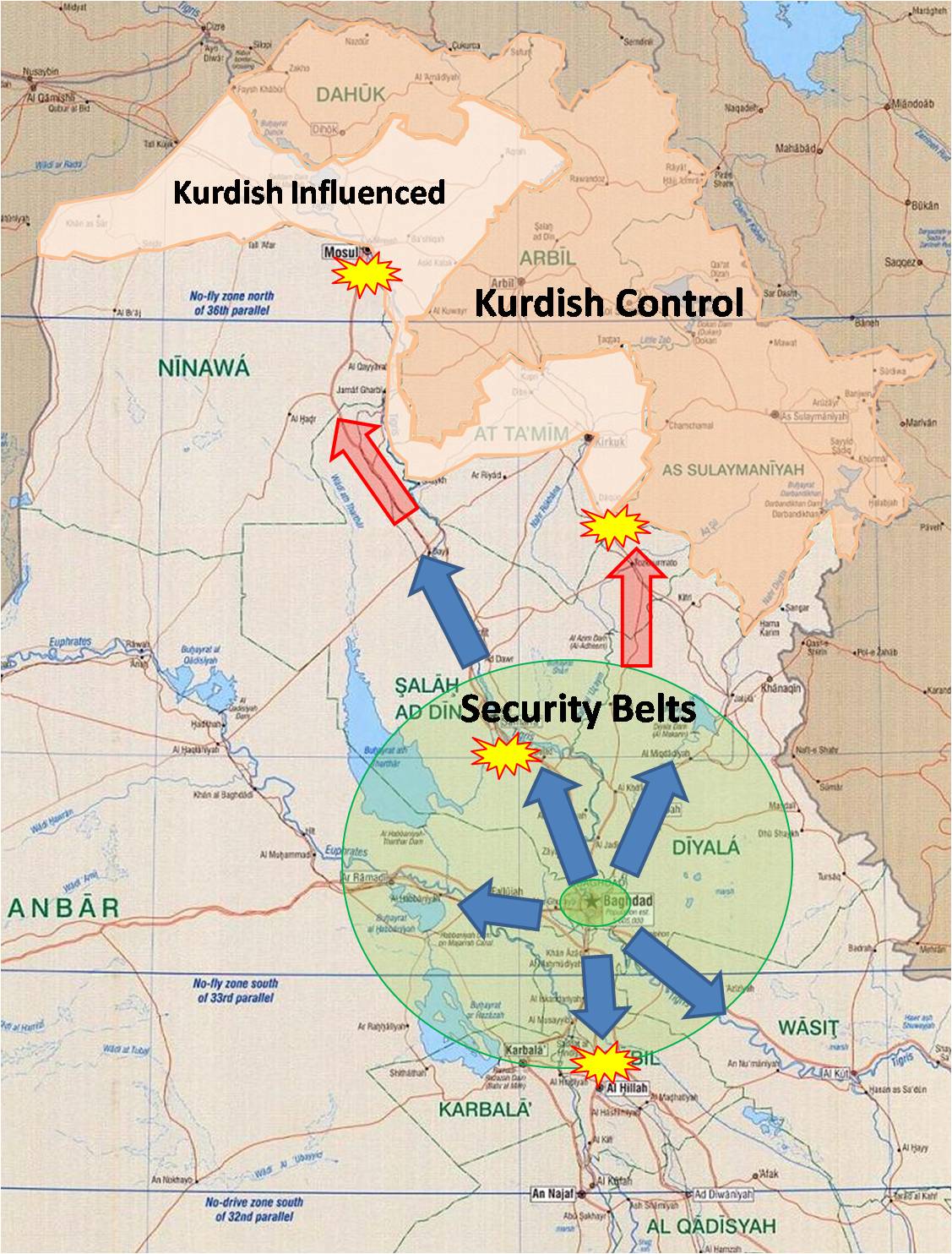
This leads to another question, what are the certain places north of Baghdad. MNF-I has made great strides in clearing Al Qaeda along the corridor from Baghdad to Mosul as they have from Baqubah to Kanaqin from all accounts I have read; however, I have not read of any reports of attacks or battles from Kanaqin to Kirkuk.

Looking at a topographical map, the area to the northeast of this road tends to become mountainous.

One wonders if this is where the remaining 25% of Al Qaeda are waiting out and/or regenerating their forces? Is this the "coming fight" that Maj. Gen. Khalaf is talking about? And is this the priority for destruction that Gen. Petreous is talking about?

It will be interesting to see if MNF-I reports of captured/killed Al Qaeda terrorist begin coming from this area.

Lessons From the Surge

Michael Barone writing for Townhall has three lessons we should take from The Surge.

Lesson one is that just about no mission is impossible for the United States military.

Lesson two is that societies can more easily be transformed from the bottom up than from the top down.

Lesson three is that it doesn't pay to bet against America.

It is an interesting read. Click here for the full article.

Iraq tribal sheikhs stress on Iraq unity

Alsumaria reports on the outcome of a meeting in Damascus of a number of Iraqi Tribal Sheikhs and Clerics,

The meeting concluded that Iraq’s unity is a red line that cannot be overcome under any circumstances.

It is clear that Iraqis want a unified Iraq first and foremost. Participants involved included,

Head of Shumar tribe and president of the tribal council Sheikh Aziz Nazhan Al Sadid told Al Hayat Newspaper that among tribal sheikhs whom signed the final statement of the meeting were Sayyed Ali Sheikh Ghomar from Baghdad, Sheikh Safir Hadi Al Ubadi from Karbala, Sheikh Khayrallah Al Basri from Basra in addition to Sheikh Fandi Shanshoul Al Farhoud from Al Rumaytha, Al Diwaniya, Sheikh Raed Abu Kalal from Najaf and cleric Jawad Al Khalesi as well as a large number of Arab tribal sheikhs.

In its final statement,

Tribal sheikhs vowed to assure Iraq’s unity, denounce partition, call to withdraw foreign forces from Iraq and prevent the interference of neighboring countries in its internal affairs as well as preserve its national identity as a country belonging to Arabic and Islamic environment. The statement urges Iraq’s neighbors not turn Iraq into an arena to settle their disputes or impose their influence. It called as well on the Iraqi government to expand the scale of national reconciliation so that it would include all Iraqis and end apportionment that takes grip of Iraqi politics as well as to reinstate former Iraqi army recruits.

While the Tribal Sheikhs called for a withdraw of foreign forces from Iraq, it is interesting to note that this statement did not specifically reference US forces as many other statements do. Instead the statement ties withdraw of foreign forces to interference of neighboring countries in Iraqi internal affairs.

It would be interesting to be able to read the subtleties of this text in Arabic.

Al Sadr followers protest in Iraq Najaf City

Iraqi, Alsumaria TV Network reports on Al Sadr protesters in Najaf,

A source from Al Sadr’s office told Al Hayat Newspaper that the number of participants in the demonstration exceeds 500 protestors noting that US security forces have prevented some protestors from reaching Najaf while they arrested others.

While Sadr's representative blames US forces for preventing participation, I believe it is more reflective of Sadr's current lack of popularity.

Poland to send additional 400 troops to Afghanistan

The Herald Tribune reports,

Poland's government is expected to send 400 additional troops to its mission in Afghanistan, a move of increased importance amid destabilization in neighboring Pakistan, the nation's defense minister said Friday.

In addition,

Poland is also planning to send some 350 troops to Africa as part of a European Union mission to protect refugees in Chad.

While many pundits say the support for the war in Iraq is dminishing by citing countries which are pulling forces out of the region,

Warsaw has announced it is pulling its 900 troops out of the U.S.-led mission in Iraq by late 2008.

At least this article shows that while Poland is pulling 900 forces out of Iraq, Poland is similarly increasing its committment to Afghanistan and Chad.

With Al Qaeda defeated in Iraq, it is only logical for countries to pull out of Iraq and plus up other hotspots.

2007: A Global Assessment of the Confrontation - Walid Phares

Dr. Walid Phares provides a country by country outlook for 2008 with regards to the Global War on Terror.

The conflict we call the War on Terror still continues at the end of 2007 and all indications are that its battlefields are expected to spread further, and escalate, in the upcoming year.

The following is a global assessment of the confrontation that has taken place since 2001, though the systematic war waged by the Jihadi forces against democracies and the free world began at least a decade before 9/11. This evaluation isn't comprehensive or definitive, but a collection of observations related to major benchmarks, directions and projections.

For a full read, click here.

Top 10 Climate Myth-Busters for 2007 - Steve Milloy

Steve Milloy gives us the Top 10 Global Warming Myths for 2007 in this Fox News article,

1. Cracked crystal balls. Observed temperature changes over past 30 years do not match IPCC predictions.

2. The big yellow ball in the sky. The sun is a major contributor of changes in temperature experienced in the 1990s.

3. Pre-SUV warming. Globally averaged temperature 1,000 years ago was about 0.3 degrees Celsius warmer than the current temperature.

4. A disciplined climate. Positive feedback loops causing ever increasing heating have been shown to be inaccurate.

5. A gnarly wipeout. A decrease in artic circulation observed in 2005 was well within historical variations.

6. A pollution solution. Solid particles suspended in the atmosphere (called “aerosols”) that make up “brown clouds” may actually contribute to warmer not cooler temperatures.

7. Lazy temperature? Researchers reported that the rate of manmade carbon dioxide (CO2) emissions was three times greater during 2000 to 2004 than during the 1990s. However, this activity isn’t having any sort of discernible or proportionate impact on global temperatures

8. Don’t plant that tree! While tropical forests exert a cooling influence on global climate, forests in northern regions exert a significant warming influence on climate.

9. The Tropical Arctic. During a period of intense global warming 55 million years ago -- when the Arctic Ocean was as warm as 73 degrees Fahrenheit -- there was a tremendous release of greenhouse gases into the atmosphere. However the release was after the warming.

10. Much ado about nothing. If we adopt all IPCC recommendation vice if we do nothing, will will only have a 0.17C effect on temperature. Doing nothing is free, doing everything costs trillions and trillions of dollars.

All of these obsevations and conclusions are based off of real observations which can be repeated empirically in experiments and not Hollywood fantasy movies loaded with special effects.

Full a full read of the myths with several linked references to scientific findings, click here. One will note, this article has dozens upon dozens of references validating their accuracy and correctness unlike many other articles that make wild claims but do not provide the facts behind the claims.

Pakistani Government begins building case against Al Qaeda and the Taliban in Bhutto's assassination

WorldNetDaily has an article in which Interior Minister Hamid Nawaz states that the whole mystery of Bhutto's assassination has been resolved.

"We have the evidence that al-Qaida and Taliban were behind the suicide attack on Benazir Bhutto,"

This evidence is based on an "intelligence intercept" between Baitullah Mehsud, a known Al Qaeda loyalist which the Pakistani government has released the transcripts for.

Maulvi Sahib (MS): Asalaam Aleikum (Peace be with you)
Baitullah Mehsud (BM): Waleikum Asalam (And also with you)
MS: Chief, how are you?
BM: I am fine.
MS: Congratulations, I just got back during the night.
BM: Congratulations to you, were they our men?
MS: Yes they were ours.
BM: Who were they?
MS: There was Saeed, there was Bilal from Badar and Ikramullah.
BM: The three of them did it?
MS: Ikramullah and Bilal did it.
BM: Then congratulations.
MS: Where are you? I want to meet you.
BM: I am at Makeen (town in South Waziristan tribal region), come over, I am at Anwar Shah's house.
MS: OK, I'll come.
BM: Don't inform their house for the time being.
MS: OK.
BM: It was a tremendous effort. They were really brave boys who killed her.
MS: Mashallah (Thank God). When I come I will give you all the details.
BM: I will wait for you. Congratulations, once again congratulations.
MS: Congratulations to you.
BM: Anything I can do for you?
MS: Thank you very much.
BM: Asalaam Aleikum.
MS: Waaleikum Asalaam.

Also, apparently Bhutto did not die from a bullet wound nor from shrapnel, but instead died from,

Cheema, however, contended today Bhutto was killed when she tried to duck back into her vehicle after the campaign rally. Her skull was fractured, he explained, when shock waves from the blast smashed her head into a lever attached to the sunroof.

As I have stated before, while Musharraf has been weakened by this event, he will/is using the event to build his case against the popular Taliban and Al Qaeda forces in his country to ensure popular support for his military when they attack these terrorists in the future with the aid of US Special Forces and American precision airpower.

The revelation that Bhutto was killed by striking a lever on the sunroof of her car and not from a bullet or shrapnel will also give credance to the Pakistani forces that they did all they could to prevent her assassination. If rogue elements are found to have assisted in her assassination, this revelation will give Musharraf leverage to rid his government (read ISI) of pro-Taliban individuals.

It is in Musharraf's best interest not to delay the 08 January Parlimentary elections. It is also in his interest to get a anti-Al Qaeda Pakistan People's Party (PPP) ally into the government in his eventual battle against Al Qaeda and foreign Taliban in the FATA region.

Bhutto's husband will deliver instructions Sunday, 30 January 2007 for the future of the PPP, stating,

that she left instructions about the future of the Pakistan People's Party to be read in the event of her death, which would be made public on Sunday.

These instructions will be read by the couple's son on Sunday.

Getting the election over and done with and getting a PPP Prime Minister into power to establish a popularly elected coalition against Al Qaeda and the foreign Taliban is crucial to Musharraf if he is to begin using US assistance to bring the war to Al Qaeda in the FATA region.

His Army can prevent any infiltration of insurgents out of the FATA region and American high tech UAVs and airpower can systematically destroy Al Qaaeda/foreign Taliban safe havens all in the name of retribution and vengence for Bhutto's assassination.

The end result is this buys Musharraf a few more years until subsequent elections where he and the PPP will have to answer to the people again. If successful, his popularity will increase as will the PPP's, Al Qaeda and foreign Taliban will be significanlty degraded if not defeated, and Pakistan will once again be united, moving forward with economic projects to enhance his country's wealth to include several oil pipelines, here and here the recently completed (and soon to be enhanced) port in Gwadar to bring these oil supplies and other goods to the Arabian Sea and to the international market.

Noting the route of both of these pipelines, especially the one from the Caspian Sea, it is critical to the future prosperity of Pakistan to assist Afghanistan in it battle against the Taliban. However, until Bhutto's assassination, he has not had the popular support to wage full up war against Al Qaeda.

Her assassination and the upcoming January elections may change all that. One can only hope that Pakistan can go forward with US assistance in a battle against Al Qaeda as the FATA region is Al Qaeda's current unassailable base from which it continues its campaign of exporting terror and economic depression, not only in Pakistan, but also in Afghanistan and to the rest of the world.

Muqtada al-Sadr's Power Grab

Middle East Online has an interesting read on Muqtada al-Sadr's plan to become an ayatollah,

The bad boy of Iraqi politics is going back to school. Muqtada al-Sadr, leader of Iraq's largest Shiite militia, is studying to become an ayatollah. It might seem like a minor development within Iraq's notoriously insular Shiite politics, especially against the backdrop of daily bloodshed. But Sadr's decision has enormous implications for Iraqis and the United States.

It is well known that Sadr is opposed to a US presence in Iraq. His militia is known to have death squads which forced many Sunnis from their home and many of his followers have infiltrated Iraqi Security Forces. In addition, Maliki owes his Prime Ministership to Sadr as he gave Maliki his 30 seat vote to prevent Hakim from instilling his own people in the government. Politically, he is very strong and now,

Sadr is working to enhance his political influence, claiming the heavenly mandate that comes out of being an ayatollah. The disobedient child is on his way to becoming a master teacher -- and an even more formidable kingmaker in Iraq.

Given his anti-American rhetoric and actions, the US really needs to watch Sadr.

US beefs up Pakistan force

The Australian is reporting,


US Special Forces are to increase their presence in Pakistan amid assessments that the country is to become the central battlefield for al-Qa'ida as it is driven from Iraq.

It must be noted that while this article is posted as of 28 Dec 07, it appears to have been written before Bhutto's assassination as it talks about beefing up security around her during her stadium rally. This fact makes this article interesting when also taken together with these article from the American Thinker here and here. Further in The Australian article, it states,

The Washington reports reflected Pentagon frustration with the Pakistani counter-insurgency effort, and said the head of the US Special Operations Command, Admiral Eric T. Olson, had made a series of visits to the country for discussions with senior military leaders.

"The first US (Special Forces) personnel could be on the ground in Pakistan early in the new year", according to the reports.

US Central Command chief Admiral William Fallon said the US forces would provide training and mentoring based on the US experience with the insurgencies in Iraq and Afghanistan.

Now lets tie some things together here.

1. Al Qaeda is on the ropes in Iraq and Afghanistan. In response, it is pulling jihdists intended for Iraq to surge efforts in Pakistan and Afghanistan in the second half of 2007. The best it has done is cause massive Taliban deaths Afganistan as these forces have attempted mass attacks against ANA and Coalition forces.

2. Al Qaeda is attempting a hostile take over of the Taliban by younger, non-Afghanistani commanders as older Taliban commanders are beginning to look for inclusion into Afghanistani politics.

3. Al Qaeda is attempting a hostile take over of Pakistani Taliban to expand its influence and territory in Pakistan and because of rifts between the Pakistani Taliban and Al Qaeda. One of these missions caused the death of many Uzbeks in the Tora Bora region in August of 2007.

4. Pakistani security forces take over the Red Mosque and kill its leader and several other militants.

5. Musharraf declares emergency rule, and during this time moves tens of thousands of troops from Kashmir to the FATA region and begins going after Al Qaeda and Taliban in Swat and other FATA regions. He obviously is more concerned about his northwestern region than he is about his border with India.

6. Now US Special Forces wll begin operating in Pakistan to "train and mentor" Pakistani forces on the counter-insurgency fight.

Does the Pakistan Military need "training and mentoring" or does it need US Special Forces to secretly target Taliban and Al Qaeda leaders with sophisticated US weaponry from Predator drones and American aircraft as Pakistani forces continue to push into FATA regions and Swat?

Given all the linkages above and Al Qaeda recent assassination of Bhutto, I would speculate that Musharraf can now begin to use American forces inside Pakistan to battle the Al Qaeda and, to a lessor extent, the foreign Taliban without major unrest from the population as they are now focused on Bhutto's assassination and bringing to justice those responsible.

The bullet which struck Bhutto, may very well be the first shot fired causing the eventual destruction of Al Qaeda and foreign Taliban within Pakistan. If true, having lost its unassailable base, Al Qaeda will be powerless to influence Iraq, Afghanistan, and Pakistan in 2008 and a major strategic victory in the Long War will have been won with most of the MSM is caught wondering how it all fell apart for Al Qaeda so rapidly when just one year ago all thought the War on Terror was lost and we must begin bringing troops home.

2008 will definitely be the year to keep an eye on developments inside Pakistan. As Pakistan goes, so goes Afghanistan and possibly Iraq. Al Qaeda has made a bold move in assassinating Bhutto, but if the above linkages are correct, the bullet that struck and killed Bhutto will ricochet and mortally wound the person who started all this carnage on 9/11.

Given the timing of the eventual distruction of Al Qaeda in the FATA region, US and Coalition forces in Iraq and Afghanistan and possibly Pakistani forces in southern Pakistan may very well be postured to diminish the threats of another adversary in the region -- Iran.

For all the tactical and operational setbacks in the Long War, the stars have started to align for victory in Iraq, defeat of the Taliban in Afghanistan, and destruction of Al Qaeda in Pakistan. Terrorist groups, like the PKK, are being dealt a significant blow in northeastern Iraq by Turkish forces. If all events unfold around summer of 2008, Tehran will be in a precarious position indeed having seen its Shia Cresent in 2007 reaching from Iran to Lebanon collapse in a short matter of months as forces surround its country signalling it to back down or suffer the same fate as the forces it was just recently helping to kill and main US and Coalition forces in the region. So too will Al Qaeda wonder how such a tragedy befell it.

2008 wll definitely be a year to watch.

The War on Terror Comes to Pakistan

Ray Robinson, writing for the American Thinker, has another take on the assassination of Bhutto,

After the US liberation of Afghanistan in 2001, the Taliban and its al Qaeda affiliates emulated the Viet Cong in the 60's, and based their operations in the security of a neighboring country. In this instance, Pakistan assumed the role that Cambodia once served, as a sovereign haven from attack. Their ability to relocate into Pakistan and turn a perceived defeat in Afghanistan into an advantage so quickly suggests to some, including me, that al Qaeda had already planned this in response to the reprisals sure to come after the 9/11 attacks. Such a strategy plays against the predictable American reluctance to expand a war.

Mr. Robinson notes that the War on Terror already came to Pakistan prior to Bhutto's assassination with an internal split among the Taliban.

The conditions that led to this change have been reported here but nearly nowhere else in the U.S. The coalition forces have managed to split al Qaeda from a politically important Islamic militant leader in Pakistan. That man leads the Pakistan portion of the Taliban; he helped to create it in the 90's. Pitting him against al Qaeda has split the Taliban.

Since Al Qaeda has lost in Iraq, its leadership has reckoned they have nowhere else to go if they lose the support of the Taliban. With the Taliban split jeopardizing its' support base, al Qaeda has been forced into a position of attempting a hostile takeover of the Taliban, supporting young leaders to overthrow the old leaders who are allied with the Pakistan-based leadership.

In explaining the reason for Musharraf's emergency rule, he notes,

Musharraf, though certainly stepping on a lot of toes with his emergency declaration, has used this time to redeploy his forces, which were stagnant on the border with India, into combat. For the first time, he is sending large scale maneuver forces backed by artillery, tanks, and air support into regions controlled by al Qaeda and the sympathetic Taliban. His forces have reportedly driven the Taliban and al Qaeda forces of Maulana Fazlullah into the hills. The Pakistani military has even followed these terrorists into the administered areas which Musharraf effectively turned over to the Taliban over a year ago.

The reason that Al Qaeda is now attacking in Pakistan is that their base is under attack; first from the internal Taliban split and secondly from the Pakistan Army's redeployment during emergency rule from the border of India to the western tribal areas.

This is an indication that al Qaeda is desperate, has redirected forces once meant for Iraq and is willing to crush the same people who have hosted them in Pakistan. In effect, they are doing the same thing in Pakistan that led to their defeat in Iraq. Only this time, they have no other strong support base to fall back to if they lose the Pakistan tribal regions.

To support his claim that Al Qaeda is attempting a hostile take over of the older Taliban with younger commanders, he notes,

The most critical indicator is that the MMA, the extremely militant Islamic party that opposes Musharraf, has remained mute as the army has slaughtered its Taliban and al Qaeda brethren.

Finally, he notes Bhutto's assassination may well be like Al Qaeda's attack on the Golden Mosque.

The assasination of Benazir Bhutto may well be one last attempt to get the Pakistanis fighting among themselves, much as the attack on the Golden Dome temporarily set Shia against Sunni in Iraq. May this attempt at stirring up trouble fail even faster.

However, while almost bringing Iraq to a full fledged civil war, this tactic failed as Al Qaeda lost active and tacit support from the populous. They lost tacit support from the Iraq population in general and later active support from Sunni tribes as they attempted to co-op these tribes under the Al Qaeda in Iraq banner.

In Pakistan too, Al Qaeda is attempting to co-op the Taliban under the larger Al Qaeda banner. In Pakistan too, Al Qaeda has struck at a symbol, this time Bhutto, which had the same significance to Pakistani's as the Golden Dome did to all Shias and many Sunnis.

However, this time, attacks against Al Qaeda will occur at its base which up to now has ben unassailable. The first thing an insurgency needs is an unassailable base. Al Qaeda has potentially brought the battle directly to its base. We will see if it is unassailable.

The Battle of Pakistan

Christopher D. Geisel writes for The American Thinker about the opening salvo in the Battle for Pakistan,

The assassination of former Prime Minister Benazir Bhutto means that the nuclear-armed Islamic Republic of Pakistan is now a battleground just as important as those in Iraq and Afghanistan in the global war against the radical Islamists.

He notes that radical islamists must be desparate to open this new front when considering their situation in Iraq,

While Iraq is by no means fully stabilized as of yet and while there is no certainty that Prime Minister Nouri Al-Maliki's government will be able to achieve the national reconciliation viewed as critical to the long term peace and stability of his fledgling constitutional democracy, there are still good reasons to be optimistic about the future of Iraq.

And Afghanistan,

Meanwhile, we have witnessed the lasting success of the 2001 liberation of Afghanistan from fundamentalist Taliban control. With everything that we have heard about a resurgent Taliban, which has stepped up deadly attacks against America and its NATO allies there, they have been unable to significantly undermine President Hamid Karzai's constitutional government.

He is saying that Al Qaeda chances of success are Iraq and Afghanistan are now minimal, so they had to open a new front. However, he notes that while Afghanistan and Iraq were global offensives against radical islamist, Pakistan is their counter-offensive.

But now the first major new front in the global conflict has been opened not by the forces of freedom but by the Islamists. December 27, 2007-while not the first day of the attempt by radicals to destabilize Pakistan-is the day of the first great success for the forces of darkness there, the beginning of what may evolve into a significant counter-offensive.

He goes on to point to the ultimate objective of assasinating Bhutto,

Moreover, as the first woman to be elected leader of a Muslim state, Bhutto represented the ultimate antithesis of the radical Islamist vision of restoring an Islamic caliphate, ruled by sharia law, with women treated as second-class citizens.

When looking at the consequences of Bhutto's assassination, perhaps even more important than the blow to liberal democratic reform is the immediate destabilizing effect on President Musharraf's government.

While I generally agree with Mr. Geisel's premises, I note that Somalia was another front opened by radical islamists; however, that too was cut short by Ethiopia. Algiers may also be another front that was attempted to be opened or is still being opened.

But, I definitely agree that Pakistan was an extremely bold move which puts radical islamists closer to their ultimate desire, nuclear weapons. Politically, they have a great chance of success in Pakistan by formenting a civil war in which the US can only give Musharraf indirect assistance.

The people of Pakistan would not welcome American forces in their country in the slightest, even if we had the numbers to surge their, which we do not. However, indirect assistance may be enough. Supporting aerial reconnaissance and attack aircraft to Musharraf forces may allow him to once and for all defeat radical islamists.

The opening of the Pakistani front in the Long War by radical islamists in order to acquire nuclear weapons was bold indeeed; however, it also opens up radical islamists to direct attacks in what was once a safe haven where they were able to train and export terror to their other fronts. A counter-attack against their counter-offensive is the only way to defeat them wholesale. Bold actions require bold reactions. I hope the US is not too tired in these early stages of the Long War to take advantage of the opening radical islamists just gave us.

PKK Militant Who Escaped Zap PKK Camp Called His Mother: "346 People Died Here

MEMRI is reporting that 346 PKK rebels were killed in Turkish Air Strike,

"346 of our friends died here. There are those who are wounded. Anti-aircrafts were destroyed. The Zap camp is wiped out".

His mother apparently told him to leave, but he stated,

"I can’t. Six people including a woman tried to run away and surrender; they were executed by the organization".

Al Qaeda takes credit for Bhutto assassination

Bill Roggio states that Al Qaeda is taking credit for Bhutto's assasination,

Al Qaeda's central command is taking credit for today's successful assassination of former Prime Minister Benazir Bhutto. A senior al Qaeda military leader in Afghanistan has contacted Syed Saleem Shahzad, a Pakistani journalist for the Asia Times and Adnkronos International with close connections to the Taliban and al Qaeda, and bragged about killing Bhutto.


I stated again, it will be interesting to see how Pakistani's react to this assasination. While trust in Musharraf's competence will surely be questioned, will he use this assasination to turn forces on the Taliban and Al Qaeda? Will Pakistani's support him? Or will Al Qaeda gain more control in as a result?

This assasination was a bold attempt by Al Qaeda. Bold moves have bold purposes, and sometimes do not have the intended affects desired. It may very well work to their advantage, but Musharraf can also use this assasination to his advantage to seek popular support against Al Qaeda and the Taliban. They next few days will be interesting indeed.

Talabani Changes on Algiers Accord

IraqPundit states,

Iran's Foreign Minister Manoushehr Motakki said yesterday that his country considers the Algiers Accord still valid.

Moreover, Talabani stated,

Meanwhile, a statement [Arabic] released today by the president says that the Algiers Accord remains valid and cannot be made void by one party alone. Talabani says in the statement that the deal was still valid according to international laws and agreements.

I agree with IraqPundit, "Wonder what that's all about."

Benazir Bhutto - Killed by the real Pakistan.

NRO's Andrew C. McCarthy has a great article about Bhutto's assasination. His last paragraph says it all and needs no explanation.

But we should at least stop fooling ourselves. Jihadists are not going to be wished away, rule-of-lawed into submission, or democratized out of existence. If you really want democracy and the rule of law in places like Pakistan, you need to kill the jihadists first. Or they’ll kill you, just like, today, they killed Benazir Bhutto.

To read it all, click here.

More than 4500 Taliban members defect

The Herald reports,

More than 4500 Taliban insurgents have defected since 2005 and up to 4000 others have been killed in action against British and Canadian forces in southern Afghanistan, according to military intelligence sources.

A British officer with wide experience in Helmand told The Herald yesterday,

"We reckon that the Taliban has lost perhaps two-thirds of its field commanders in Helmand and Kandahar in the last year or so. That has weakened its tactical structure, although it is unlikely to stem the flow of paid or religiously motivated recruits.

Not only has persuasion from British and Afghan forces helped, but apparently so has NATO airpower which is the single largest cause of casualties.

It goes to show that negotiations should always start from a position of strength.

On the march with Helmand’s hope

Nick Meo writes from the newly resecured Helmand town of Musa Qala.

WITH A Bollywood tune blaring from the pick-up truck's sound system and a giant Russian anti-aircraft gun swivelling on its back, an Afghan National Army (ANA) patrol roared down Musa Qala's main street in a cloud of dust, past a group of amused British soldiers.

Mr. Meo goes on to talk about the Afghan National Army (ANA),

They don't look like a very conventional military force. Armed with old Soviet weapons and recruited from the ranks of veteran militiamen and eager youngsters from the length and breadth of the country, at first sight they bear more than a passing resemblance to the private armies that have wrought mayhem in Afghanistan for 20 years.

But they are tough, regarded as good fighters, and disciplined, even if they do dress up in a motley collection of kit, with a liking for baseball caps instead of steel helmets and a taste for adorning their weapons with roses plucked from the gardens of the people they have come to liberate.

The ANA is, however, perhaps the only institution in the new Afghanistan which works.

Government has been dogged by corruption and incompetence; opium eradication has been a disaster; the police are regarded as little better than brigands in uniform. But the ANA is a disciplined force which has brought together Afghans from all ethnic groups into one effective institution...

Mr. Meo goes on to say,

British soldiers who have served in Iraq, often leaving with distinctly mixed feeling about Iraqi security forces, are enthusiastic about the Afghans.

I find several things interesting about this article.

1. Police Forces:

Like Iraq, the Afghan police have an issue with corruption. A police force is better if it comes from the hometown which it will patrol as it will be well known to the population and have a degree of brotherhood with the locals. This fact however, seems to cause corruption intially.

Iraq has/had this problem and is being slowly rectified. Afghan still has this problem. It needs to be rectified. NATO may want to look at the Iraqi example in ending Afghan Police corruption. While the Iraqi Police is not a resounding success, it appears from reports to be less corrupt than the Afghan Police.

2. Armies:

Army's tend not to have the amount of corruption as do police forces as they represent a larger cross section of the population as a whole. Therefore, they learn to get along with brothers in arms who may be of different tribes, ethnicities, or heritages. Where Armies tend not to be corrupt, they also tend to take longer to be effective than police. Police forces are typically corrupt, but effective to a certain extent from day one.

It is kind of a shell game. Get local police on the ground to establish a presence. Develop the Army. Army takes over from corrupt police. Police get retrained and then take over from Army. Army moves to a different area to start the process all over again.

The Afghan National Army is now a potent fighting force, but it is too small to control the country. This sound very familiar to Iraq only one short year ago. However, Iraq has added over 100,000 Soldiers in 2007 and now have the numbers to be everywhere to quell insurgencies leading to peace in Iraq. The Afghan National Army needs to build it numbers while maintaining its potency.

3. Timing is everything.

British Soldeirs are stating that Afghan Soldiers are tougher and better fighters than Iraqi Soldiers. However, if these British Soldiers are currently in Afghanistan, they were probably in Iraq over two years ago when the Iraqi Army was just forming. A lot of progress has been made with Iraqi Security Forces who are now in the lead in many operations, just like their Afghanistani counterparts.

4. National Leaders:

Finally, both Iraq and Afghanistan are suffering from corruption at the national level with regards to their leaders. I believe this is indictative to the development of a democracy, especially in these regions where democracy is a new method of government. It was definitely corrupt in early America.

Those in power first attempt to get rich, to line their own pockets at the expense of the people, since money talks in these regions. However, national leaders begin finding out that money is not the root of power. Right behind it is the physical well-being of the populous. If the populous is not being taken care of, they will vote leaders out of office. This is what is special about a democracy. This shocking realization about a democracy seems to hit all leaders when new elections are upcoming. They attempt to get laws passed to better help and protect the population so as to retain power.

It is hitting Maliki, Talabani, and Hashimi now which is why they are forming a coalition which represents all the people. It will be interesting to see when it hit Afghanistani leaders.

Iraq has also been able to solve one other issue that Afghanistan has not, namely national reconciliation. While not solved in Iraq at the national level, grassroot reconciliation is present in Awakening groups and CLCs. While rumors abound about some Taliban changing sides, we have yet to see this unfold in Afghanistan. It seems that this grassroots reconciliation must happen prior to corruption being lessened at the national level and national leaders starting to rule and govern for the people they were elected to represent.

While we have been in Afghanistan longer, it is moving ahead at its own pace to establish a strong, stable democracy. However, reconciliation and corruption will have to be diminished prior to the democracy becoming a potent force in and of itself.

Shiite Contest Sharpens In Iraq

WoPo's Sudarsan Raghavan is reporting today of the power struggles happening in Southern Iraq between the Supreme Council and Sadr's Mahdi Army.


The arrests of Sadr's loyalists are part of a broader power struggle between the two most powerful Shiite factions seeking to lead Iraq: the Sadrists, who are pushing for U.S. troops to withdraw, and the Islamic Supreme Council of Iraq, the Bush administration's main Shiite ally. Given the nation's majority-Shiite population, this intensifying confrontation could play a major role in deciding Iraq's future.

Where the reporter starts going off the mark is when he states that the Supreme Council is the "Bush administration's main Shiite ally". This is not true.

The Supreme Council, with its militant wing called the BADR corp, the Sadr Movement with its militant wing called the Mahdi Army, and the Dawa Party were the major parties which made up the United Iraqi Alliance List which received 41% (128 of the 275 available seats) of the vote in the December 2005 Iraqi elections. Sadr, not wanting to see Hakim (the Supreme Council's leader) come into power as the Prime Minister gave his portion of votes (30 of 128) to Maliki, from the Dawa Party in exchange for heading certain Ministries. If anything, the US is supporing the elected Prime Minister of Iraq, Maliki, who is from the Dawa Party.

Given the fact that the Mahdi Army has until recently opposed US forces in Iraq and his forces have directly engaged and attacked US and Iraqi forces and civilians, the US is not supportive of Sadr or his militia. However, since his militia has been told to stand down, US forces are only going after its rogue elements, usually with support from Sadr himself as he is attempting to eliminate rogue elements.

Similarly, the Supreme Council wants to see Iraq broken into three parts and has Iranian backing. Again, this is not inline with the US position.

Maliki for his part, has sent his President, Talabani, and Vice President, al-Hashimi to the Kurdish north where a "memorandum of understanding" with Barzani's Kurdistan Democratic Party. These groups represent about 42% of the Iraqi electorate. A union of these parties with Maliki's Dawa Party can possibly reshage the internal dynamics of Iraqi politics while keep the three major players in power.

Maliki, who is beholden to Sadr for his 30 seats, would no longer be beholdened to Sadr to remain in power. In addition, he would not be beholdened to the Supreme Council who has ties with Iran and is seeking to divide Iraq into three parts. Finally, he would gain by having strong militias which he could use as needed (from the Kurds and Sunnis).

President Talabani, from the Patriotic Union of Kurdistan and Barzani's, President of the Iraqi Kurdistan region, would gain from the union by having a larger voice in implementation of the New Oil Law and Kirkuk Referendum.

Vice President, al-Hashimi, a Sunni from the Iraqi Accord Front would gain by giving his minority Sunnis are larger voice in the political arena and be able to better influence the National Reconcilitation law and possibly allowing more Awakening or CLC groups into the Iraqi Security Force structure.

The coalition Maliki is attempting to foster would leave both the Supreme Council and Sadr movement without much power and quite frankly would be better postured to pass needed laws to move the country forward, be better representative of all pro-Iraqi groups, and ensure that these people stay in power after the 2009 elections.

For the time being, Maliki is letting the Supreme Council and Sadr Movement duke it out in the south while he builds a truly Iraqi, secular coalition to get needed laws passed.

This dynamic is what is truly happening on the ground in Iraq. Not only is Sadr being sidelined, but so is the Supreme Council. Both organizations are only out to better themselves and not the Iraqi people as a whole.

This new Coalition will have a majority in Parliment, represent all parties, Shias, Sunnis, and Kurds, and be able to pass and enact laws to better all these parties so they remain in power after the upcoming 2009 elections. If this coalition succeeds, it will represent the success of a capitalist democracy very similar to operations to our own democracy.

Pakistan's Bhutto killed in attack

Yahoo/AP reports that Benazir Bhutto was assassinated Thursday.

A party security adviser said Bhutto was shot in neck and chest as she got into her vehicle to leave the rally in Rawalpindi near the capital Islamabad. A gunman then blew himself up.

This is a very unfortunate event. However, while Yahoo quotes the following,

Her supporters at the hospital began chanting "Dog, Musharraf, dog," referring to Pakistan's president Pervez Musharraf. Some of them smashed the glass door at the main entrance of the emergency unit, others burst into tears.

I am not sure this will bode as bad for Musharraf as it will for radical Islamists in Pakistan. Nor does Musharraf have anything to gain by her death and therefore no reason to assasinate her. If he wanted to assasinate her, why let her back into Pakistan?

While Bhutto was by no means the saving grace for Pakistan that the MSM has made her out to be, she was popular to a large segment of the Pakistani population. It will be interesting to see whether a popular backlash happens against extremist Islamists giving Musharraf more leeway to battle against these insurgents in his country.

1975 Accord Still Valid - Iran Daily

Iranian Foreign Minister Manouchehr Mottaki stated today in the Iran Daily,

The Algiers Accord signed by Iran and Iraq in 1975 is internationally valid and cannot be challenged, Foreign Minister Manouchehr Mottaki said on Wednesday. Mottaki was reacting to a recent statement by Iraqi President Jalal Talabani. “The 1975 accord is an international treaty, registered with the United Nations and legally binding on the two sides,“

The above is completely tru, Further,

Mottaki expressed surprise about the shift in Talabani’s attitude, saying that the Iraqi president never expressed such a view during his several visits to Tehran.

So, why would President Talabani state the 1975 Algiers Accord was invalid?

One possible explanation.

Iran needs no uranium enrichment: Russia's Lavrov

Yahoo/Reuters quotes Russian Foreign Minister Sergei Lavrov as saying,

"We believe that Iran has no economic need to proceed with its program of uranium enrichment," Lavrov told the daily.
"We are trying to persuade the Iranians that freezing the program is to their advantage as it would immediately lead to talks with all countries of the "six," including the United States."

He further explained,

Iran was aware, he said, that should there be any deviation from agreements to build Bushehr under the supervision of the International Atomic Energy Agency, "we will freeze our cooperation."

This fact is something that most MSM outlets missed when reviewing the new NIE. Iran has not stopped it pursuit of uranium enrichment. Russia has always guaranteed fuel for the reactor at Bushehr. In fact, the make up or percent quantities of enriched uranium needed for Bushehr reactor needed to make it work has never been detailed to the Iranian by the Russian. Therefore, Iranian enriched uranium cannot be used for the Bushehr reactor unless Russia gives them the technical specification of what percentage and qualities the enriched uranium needs.

So, why does Iran continue to enrich uranium if not for purposes other than energy? Why, indeed?

Concerned Local Citizens find IED, cache in Arab Jabour

MNF-I reports that CLCs turned over a cache,

Concerned Local Citizens found an improvised explosive device formed from rigged land mines and ammunition near Patrol Base Murray in Arab Jabour Dec. 23.

The size of the cache is significant,

The weapons caches consisted of 23 shape charges, three rocket propelled grenades, two 57 mm projectiles, four 73 mm propellant charges, 20 pounds of TNT, eight projectile fuses, one RPG warhead, six boxes of DSHKA high-caliber machine gun rounds, one fragmentation grenade, six 4.5-pound blocks of TNT, five pounds of unknown bulk explosive, two pounds of PE4, and 14 120 mm mortar propellant charges.

But even more significant is the fact that this find (and others) are occuring in Arab Jabour, which until The Surge was used to transport arms from Iran into Baghdad and to a certain extent by Al Qaeda as one of the belts that supported the insurgency in Baghdad.

The battle of Baghdad has been won.

Battles currently ongoing include from Arab Jabour to Babel to Baghdad to Karbala also known as the "Triangle of Death". This is the area of operations of the 3rd ID. Also, currently in play is the "Sunni Triangle" which includes the Diyala and Salah ad Din Provinces. This area of operations (to include further north into Samarra) belongs to 1st AD.

Shia militia and Al Qaeda are being defeated wholesale in both of these areas as Concerned Local Citizens gain in strength and power. These groups are providing Special Operation forces with valuable intelligence to kill and capture leaders and members of both of these groups.

These joint Iraqi and US Military actions, taken together with Awakenings, formation of CLCs, and Talabani's/al-Hashimi's formation of a National Unity Government, do not bode well for Shia Militias nor Al Qaeda in Iraq which are being defeated wholesale in Iraq.

The Surge was meant to:

1. Enhance and promote Awakening movements which originated with the Marines in Al Anbar in order to diminish support for insurgents.

2. Quell the insurgencies (both from Shia Militias and Al Qaeda in Iraq). While Al Qaeda in Iraq was the initial focus, Shia Militias were also an ancillary objective.

3. Provide forces necessary to simultaneously execute operations all over Iraq to prevent insurgents from just relocating from one area to another.

4. Trap and destroy insurgents for eventual destruction by not allowing them to just reposition.

5. Provide breathing space for the Iraqi Government by securing Baghdad to allow it to govern to reach its benchmarks.

6. Promote National Reconciliation which is occurring now with the formation of a National Unity Government.

In six short months since The Surge has been in full force, three objectives have been accomplished, the fourth is ongoing, and the sixth may well make the fifth occur.

It is no wonder that General Petreous stated accomplishment of objectives was ahead of schedule.

All this good news has made the MSM suddenly silent on the war in Iraq, but has upheld the naming of the operation, that is Operation Iraqi Freedom.

It will be interesting to see what Iraq is like next Christmas and New Year.